Point functions
Point functions operate on AbstractGeodesicPoint, and are used to represent calculations that can be applied to any single geodesic. They usually map to some sort of physical value (an energy shift, a proper time, and so on), but can also be used to filter geodesics based on certain predicates.
PointFunctions are mainly indented for use with rendergeodesics, as short-hands for expressing how a pixel in the image should be calculated.
There are many already defined in Gradus.jl (e.g. ConstPointFunctions.redshift) but it's easy to define your own.
For example, a point function which calculates the angle from the zenith in the local coordinates at the endpoint of a geodesic. First we'll use a pre-made point function which filters those geodesics that hit some accretion geometry:
using Gradus, Makie, CairoMakie

m = KerrMetric(1.0, 0.998)
d = ThinDisc(0.0, 50.0)
x_obs = SVector{4}(0.0, 1e4, deg2rad(80), 0.0)

# use a pre-made point function
pf = ConstPointFunctions.filter_intersected()

# apply the point function to colour the image
a, b, img = rendergeodesics(m, x_obs, d, 2x_obs[2]; verbose = true, pf = pf)

fig = Figure()
ax = Axis(fig[1,1])
heatmap!(ax, a, b, img')
fig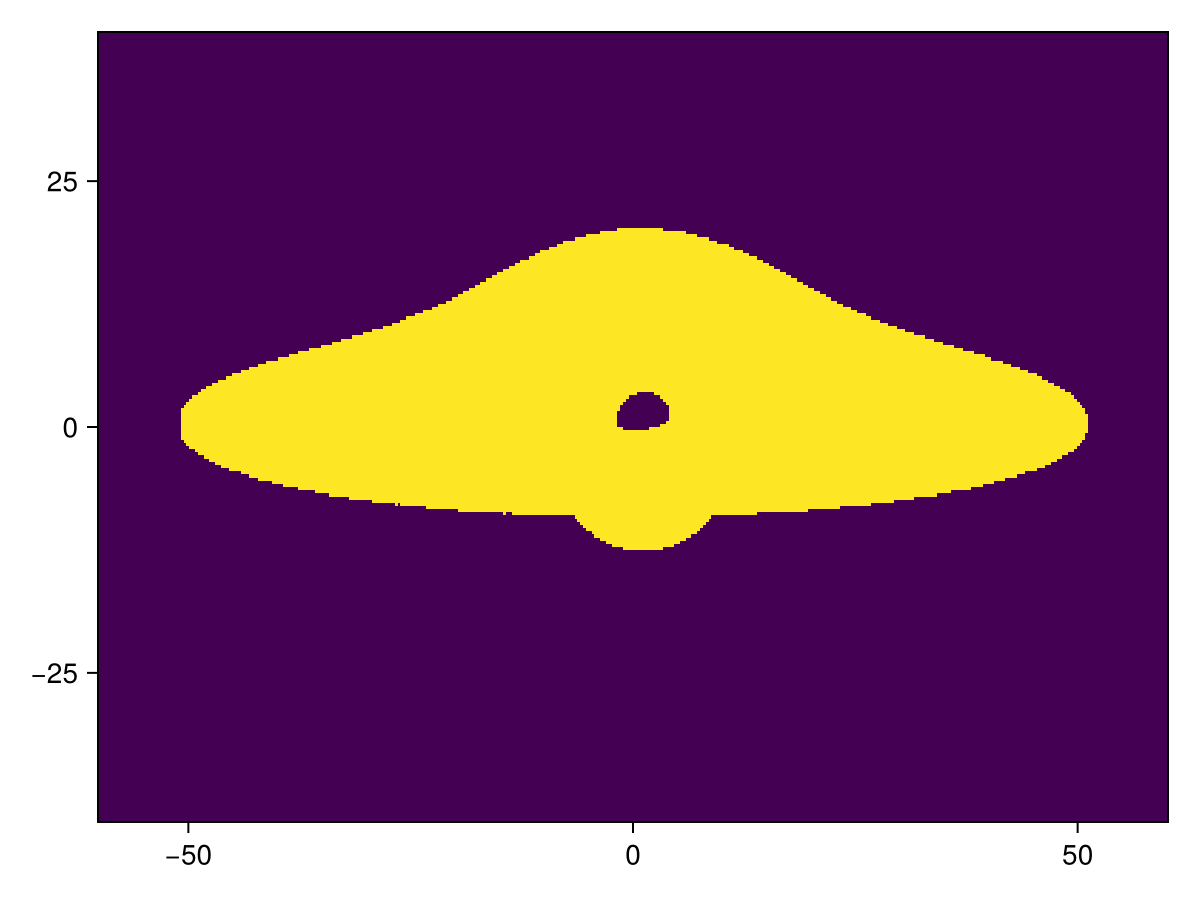
Now we'll write a point function that calculates the angle on the local sky. All point functions are given three things: the metric, the GeodesicPoint, and the value of the affine parameter.
The affine parameter argument is now redundant, since that information is included in the GeodesicPoint but exists for backwards compatibility.
We can define our function like this:
source_velocity = SVector(1.0, 0.0, 0.0, 0.0)
angle_pf = PointFunction(
    (m, gp, lambda) ->
        # Only need the first element, as we're only interested in theta
        Gradus.velocity_to_sky_angles(m, gp.x, source_velocity, gp.v)[1]
)
This can be composed together with the filter point function to first apply the filter and then our custom point function:
new_pf = angle_pf ∘ ConstPointFunctions.filter_intersected()
# Apply the point function to colour the image
a, b, img = rendergeodesics(m, x_obs, d, 2x_obs[2]; verbose = true, pf = new_pf)

fig = Figure()
ax = Axis(fig[1,1])
heatmap!(ax, a, b, img')
fig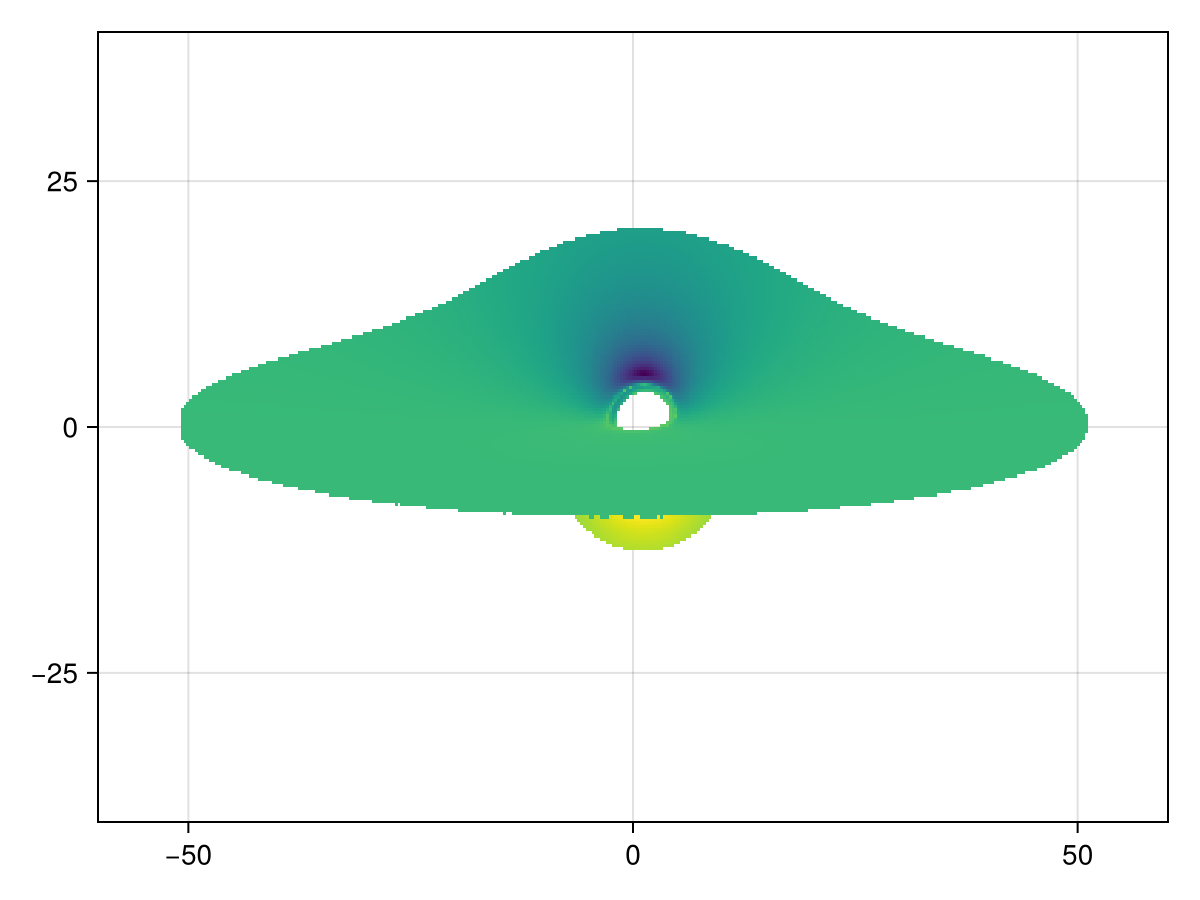
We can include the effects of the motion of the disc also. Assuming the disc has Keplerian velocities, the point function could be amened to use the local four-velocity of the disc instead of a stationary point for the angle transformation:
function to_local_angle(m, gp, lambda)
    v_disc = CircularOrbits.fourvelocity(m, gp.x[2])
    Gradus.velocity_to_sky_angles(m, gp.x, v_disc, gp.v)[1]
end

# Wrap our function as before
comoving_angle_pf = PointFunction(to_local_angle)

# And compose and trace!
comoving_pf = comoving_angle_pf ∘ ConstPointFunctions.filter_intersected()
a, b, img = rendergeodesics(m, x_obs, d, 2x_obs[2]; verbose = true, pf = comoving_pf)

fig = Figure()
ax = Axis(fig[1,1])
heatmap!(ax, a, b, img')
fig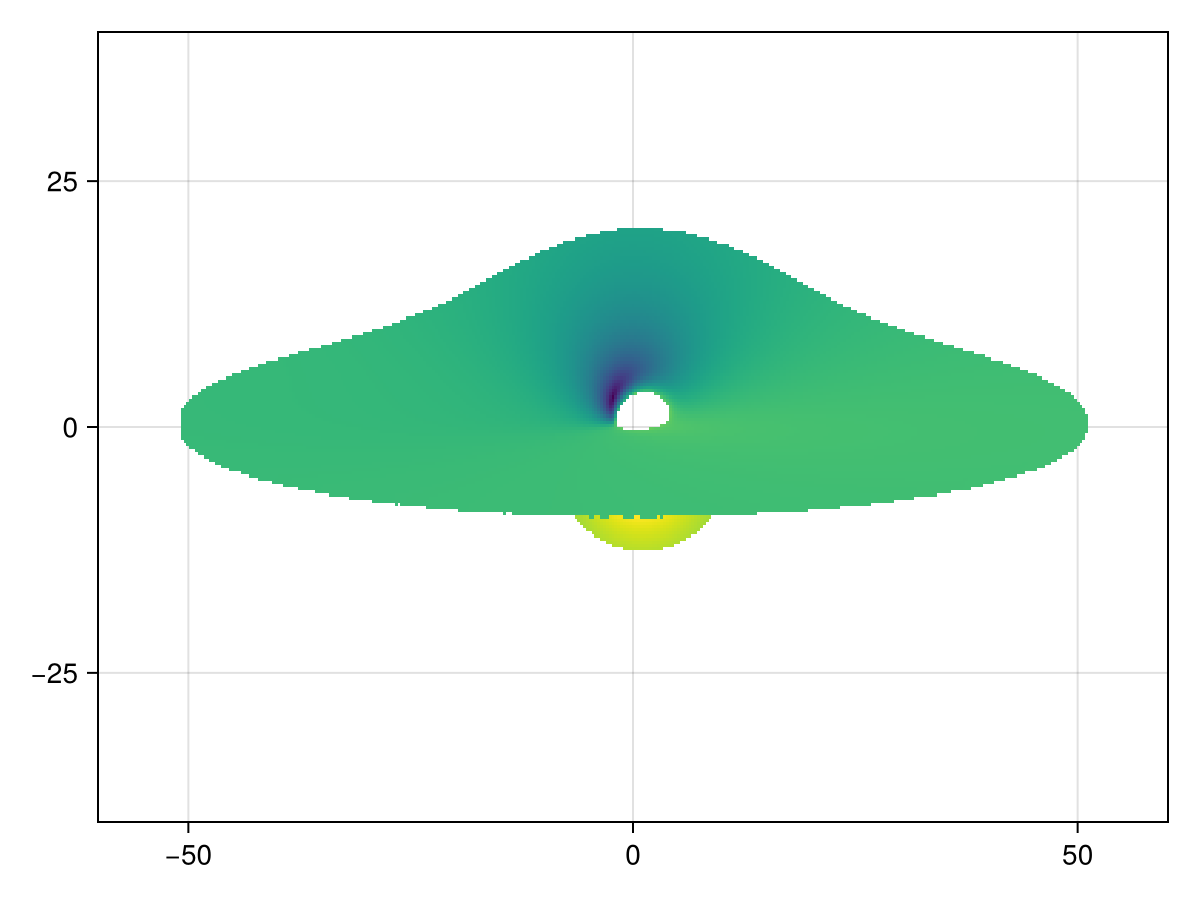
The effects of special relativistic beaming are here clear to see!
Point function documentation
Gradus.AbstractGeodesicPoint — Type
abstract type AbstractGeodesicPoint{T}Supertype for geodesic points, used to store information about specific points along geodesic trajectories.
Currently limited to storing the start and endpoint of any given trajectory. To keep the full geodesic path, it is encouraged to use the SciMLBase.AbstractODESolution directly.
Must minimally have the same fields as GeodesicPoint. Examples include Gradus.FirstOrderGeodesicPoint.
Gradus.GeodesicPoint — Type
struct GeodesicPoint <: AbstractGeodesicPointA structure that represents the start and end point along a geodesic. To obtain a GeodesicPoint, use unpack_solution or unpack_solution_full on the result of a tracegeodesics.
Fields:
status::StatusCodes.T: AStatusCodescode of the integrator for this geodesic.λ_min::T: Start affine timeλ_max::T: End affine timex_init::SVector{4,T}: Start four positionx::SVector{4,T}: End four positionv_init::SVector{4,T}: Start four velocityv::SVector{4,T}: End four velocityaux::A: Auxillary values (polarisation, intensities, etc.)
Example
sol = tracegeodesics(m, x, v, 100.0)
gp = unpack_solution(sol)
gp.statusGradus.unpack_solution_full — Function
unpack_solution_fullUnpacks each point in the solution, similar to unpack_solution but returns an array of GeodesicPoint.
Gradus.AbstractPointFunction — Type
abstract type AbstractPointFunctionAbstract super type for point functions. Must have f::Function field.
Gradus.PointFunction — Type
struct PointFunction <: AbstractPointFunction
PointFunction(func)
Point functions are functions that are used to calculate physical parameters from geodesic integrations, and to compose more complex models. A number of default and utility PointFunction are defined in Gradus.ConstPointFunctions.
Principally, point functions return a single value per geodesic, and are used to fill rendered images with values, e.g. colouring redshift.
Point functions may be instantiated by wrapping a function with the following signature
function func(m::AbstractMetric{T}, gp::AbstractGeodesicPoint, max_time::T; kwargs...)::T where {T}
    # ...
end

pf = PointFunction(func)- The
AbstractMetricargument may be used to dispatch for different metrics. gpis anAbstractGeodesicPointcorresponding to a given geodesic.- The
max_timeparameter is the maximum integration time used to integrate the geodesics. This may be useful when trying to determine whether a geodesic terminated early or not.
They may be invoked by invoking the instance
result = pf(m, gp, max_time)As of version 0.1.0, the kwargs parameter is reserved only for passing optional results when chaining multiple point functions (see below). This is subject to revision and breaking changes in future versions.
Multiple AbstractPointFunction may be chained together using the ∘ operator, and are evaluated from right to left
pf3 = pf2 ∘ pf1This may be useful for constructing filters using FilterPointFunction. When used with two PointFunction objects, the output of the previous PointFunction is passed to the next via the value keyword argument.
Gradus.FilterPointFunction — Type
struct FilterPointFunction <: AbstractPointFunction
FilterPointFunction(func, default_value)
Point functions used to filter geodesics. They may be constructed with
function func(m::AbstractMetric{T}, gp::AbstractGeodesicPoint, max_time::T; kwargs...)::Bool where {T}
    # ... return Bool
end

fpf = FilterPointFunction(func, NaN64)
The second argument to the constructor is the default value, given to the pixel if the boolean condition of func is false.
Example
A filter for geodesics within a certain radius, used to only calculate redshift within 10 $\r_\text{g}$
func(m, gp, max_time) = gp.u[2] < 10.0
pf = ConstPointFunctions.redshift(m, u) ∘ FilterPointFunction(func, NaN64)Pre-defined point functions
Gradus.ConstPointFunctions — Module
module ConstPointFunctionsModule defining a number of const Gradus.AbstractPointFunction, serving different utility or common purposes for analysis.
Gradus.ConstPointFunctions.filter_early_term — Function
filter_early_term(m::AbstractMetric, gp::AbstractGeodesicPoint, max_time)A FilterPointFunction that filters geodesics that termined early (i.e., did not reach maximum integration time or effective infinity). Default: NaN.
Gradus.ConstPointFunctions.filter_intersected — Function
filter_intersected(m::AbstractMetric, gp::AbstractGeodesicPoint, max_time)A FilterPointFunction that filters geodesics which intersected with the accretion disc. Default: NaN.
Gradus.ConstPointFunctions.affine_time — Function
affine_time(m::AbstractMetric, gp::AbstractGeodesicPoint, max_time)A PointFunction returning the affine integration time at the endpoint of the geodesic.
Gradus.ConstPointFunctions.shadow — Function
shadow(m::AbstractMetric, gp::AbstractGeodesicPoint, max_time)A PointFunction which colours the shadow of the black hole for any disc-less render. Equivalent to ConstPointFunctions.affine_time ∘ ConstPointFunctions.filter_early_term.
Gradus.ConstPointFunctions.redshift — Function
redshift(m::AbstractMetric, x_obs)Returns a PointFunction that calculates the redshift of a medium as observed by an observer at x_obs.
Calculate the analytic redshift at a given geodesic point, assuming equatorial, geometrically thin accretion disc. Implementation depends on the metric type, with non-Kerr metrics using an interpolation scheme within the plunging region via interpolate_redshift.
Calls redshift_function to dispatch different implementations.